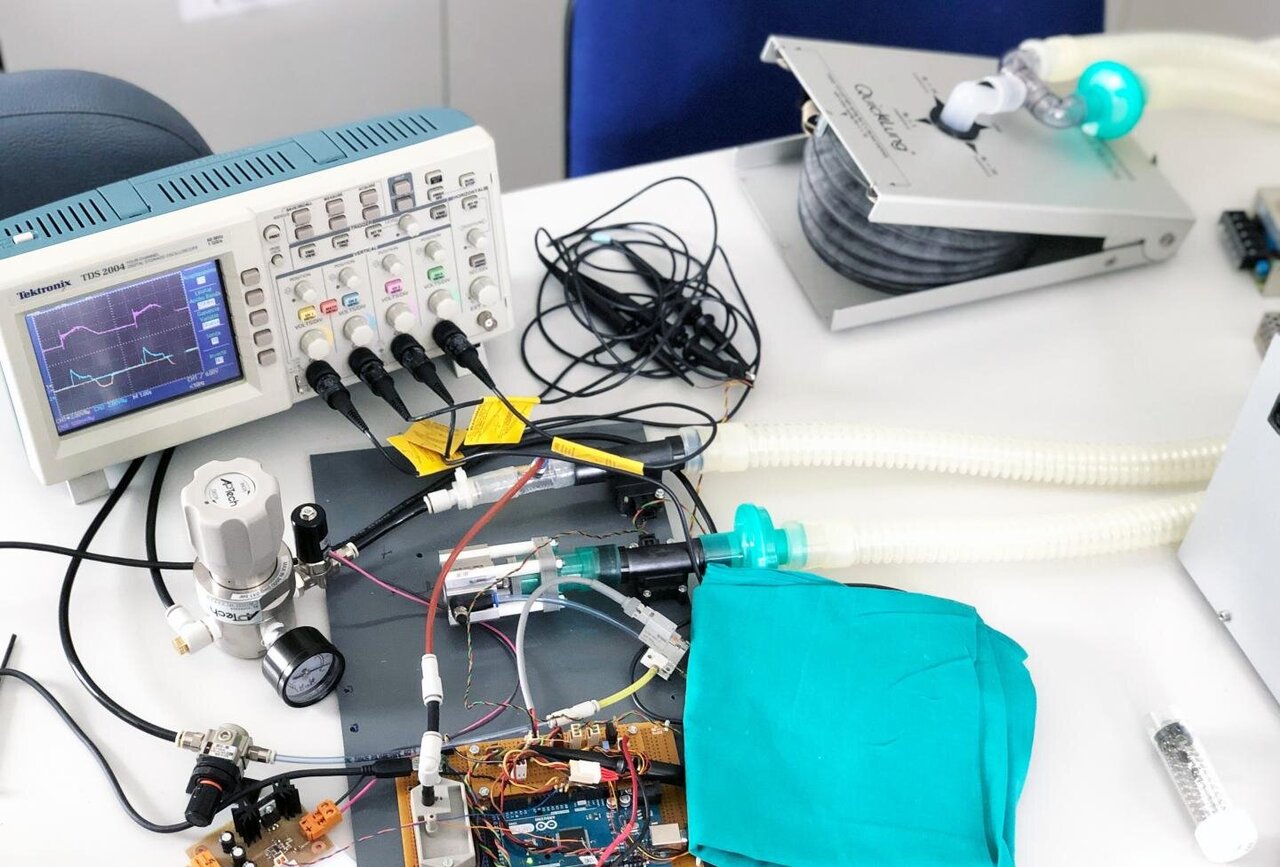
Researchers and technicians from the Universidad Carlos III de Madrid (UC3M) and the University Hospital Gregorio Marañón (HGUGM) have designed and developed a new ventilator prototype for Intensive Care Units (ICU) in the fight against the health crisis caused by COVID-19. The assembly of two units has just been completed in order to start animal tests and homologation processes.
These ventilators are an indispensable element for patients in intensive care with severe respiratory distress, for whom the mechanical ventilators being developed through other initiatives are not suitable. The project to support the development and manufacturing of these ventilators, which began on 1st April with a crowdfunding campaign organised by the Universidad Carlos III Foundation, achieved its initial funding target (50,000 Euros) in just 24 hours. With this funding, the prototype's creation and testing phases, that are performed these days, can be completed and the corresponding licenses can be processed. The current funding amount raised has exceeded 67,000 Euros, thanks to contributions from more than 1,600 individual donors and various institutions have also been interested in contributing with additional amounts to the project, amounts to be devoted entirely to the manufacture of respirators.
The health emergency caused by the expansion of COVID-19 has clearly shown the need for hospital material such as ventilators, which are an indispensable element for patients admitted to the ICU suffering from greater respiratory distress. There are ventilators available for foreseen emergency situations, known as automatic or mechanical "ambu-bags", a provisional solution that is not suitable for long-term care of patients in the ICU. For this reason, there is a need for ventilators with the necessary features to treat patients with the coronavirus who require intensive care. In Spain there is currently not sufficient industrial production of these devices and the international market does not have a sufficient supply to cover the needs during these days of the emergency nor for the coming months.

Researchers from the UC3M and the HGUGM have finished the assembling the first units of the prototype. Tests and validations using the prototypes on pigs will begin and, at the same time, the homologation process of the Community of Madrid, in accordance with current regulations and following procedures established by the Spanish Agency for Medicines and Healthcare Equipment. With the actual operation of the first ventilator units, the EC Marking will also be advanced, which will extend their international homologation and will allow these products to remain and be useful in our health care system once the current emergency situation is finished.
This project can contribute to the creation of a national industry with a certain production capacity. and autonomy to respond to needs such as those today. Especially in the face of new waves of the virus, which are a definite possibility until a large-scale vaccine has been created. In fact, campaign promoters are in contact with companies who may be interested in manufacturing, thus increasing the production capacity of equipment that is designed for accessible manufacturing, even with the complex specifications of ICU equipment. This is achieved because technology will be open, and it has been designed with components that are available from different suppliers. In doing so, an alternative to the high-end ventilators in the ICUs will be provided, thus giving a quicker and more economic response to COVID-19 patients who share very delicate pulmonary pathologies.
The ICU ventilators proposed within the project's framework function in mandatory mode and in assisted mode: the first meets the needs of patients with greater respiratory distress, who cannot breathe on their own; while with the second, the machine does not force the patient to breath, but rather assists them at their rhythm and rounds out their effort, continuously measuring the flow, volume and pressure of air that is inhaled and exhaled. Furthermore, this ICU ventilator carries out positive pressure control at end expiration (PEEP), a fundamental feature for COVID-19 patients so that their lungs are not damaged. The system informs the specialized medical staff at all times through a control panel about ventilator parameters and integrates a visualization of the graphics for lung pressure and air volume to facilitate checking that the patient is adequately ventilated.
Comments
Post a Comment